 Hylea
Hylea
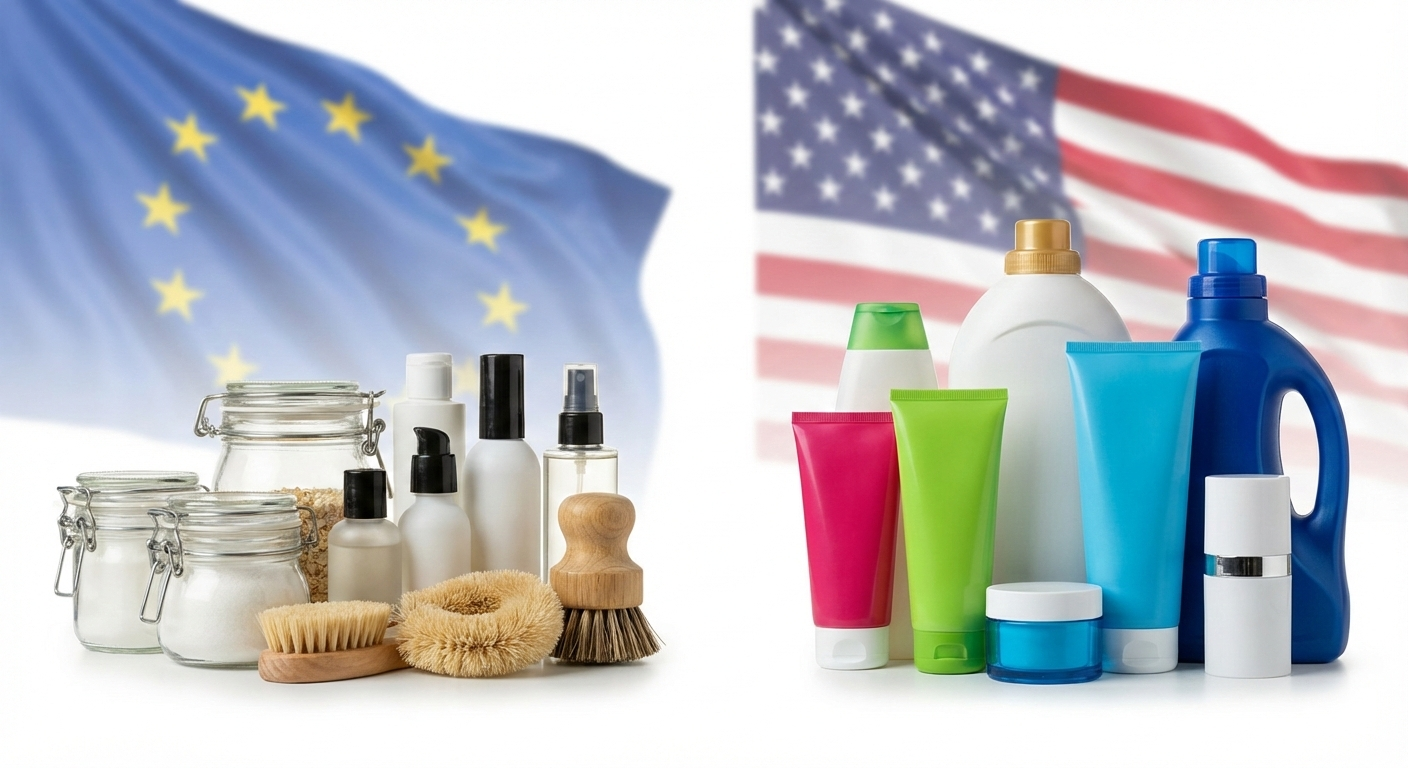
If you've ever compared the ingredient list of a product sold in Europe with the same brand's product sold in America, you may have noticed they're different. Sometimes very different. This isn't a coincidence - it reflects fundamentally different regulatory philosophies about chemical safety.
The Precautionary Principle vs. Risk-Based Approach
The core difference comes down to who bears the burden of proof. The EU generally follows the precautionary principle: if there's reasonable suspicion that a chemical could cause harm, regulators can restrict it even before definitive proof exists. The US takes a risk-based approach: chemicals are generally presumed safe until proven harmful, and the burden falls on regulators to demonstrate danger.
EU: REACH Regulation
REACH (Registration, Evaluation, Authorisation and Restriction of Chemicals), enacted in 2006, requires manufacturers to provide safety data for chemicals before they can be sold. Key features:
- Pre-market registration: Companies must register chemicals and provide safety data before placing them on the market
- 1,600+ banned cosmetic ingredients: The EU Cosmetics Regulation prohibits over 1,600 substances in cosmetics
- Candidate list of substances of very high concern (SVHC): Chemicals identified as carcinogenic, mutagenic, reprotoxic, persistent, or endocrine-disrupting can be flagged for authorisation
- Fragrance allergen disclosure: 82 fragrance allergens must be individually listed on cosmetic labels when above certain concentrations
- 'No data, no market': Without safety data, chemicals cannot be sold
US: TSCA and FDA
In the US, chemical regulation is split across agencies. The Toxic Substances Control Act (TSCA), reformed in 2016 as the Lautenberg Act, governs industrial chemicals. The FDA oversees cosmetics under the Federal Food, Drug, and Cosmetic Act.
- No pre-market approval for cosmetics: The FDA does not require safety testing before cosmetic products go on sale
- ~11 banned cosmetic ingredients: Compared to the EU's 1,600+, the US bans or restricts roughly 11 substances in cosmetics
- Fragrance exemption: 'Fragrance' can be listed as a single ingredient, hiding dozens of individual chemicals under trade secret protection
- Industry self-regulation: The cosmetics industry largely polices itself through the Cosmetic Ingredient Review (CIR) panel
- Grandfathered chemicals: When TSCA was first passed in 1976, approximately 62,000 chemicals were grandfathered in without safety testing
Real-World Differences
These regulatory differences produce tangible differences in the products available to consumers:
- Formaldehyde-releasing preservatives are restricted in EU cosmetics but widely used in US products
- Coal tar dyes are banned in EU food and cosmetics but permitted in the US
- Certain parabens (propylparaben, butylparaben) are restricted to low concentrations in EU cosmetics but unrestricted in the US
- Triclosan was restricted in EU cosmetics before the US took action
- Many hair dye chemicals banned in the EU remain available in US products
Recent Progress in the US
The US has made some progress. The 2022 Modernization of Cosmetics Regulation Act (MoCRA) introduced mandatory facility registration, product listing, adverse event reporting, and gave the FDA mandatory recall authority for the first time. However, it still doesn't require pre-market safety testing of ingredients.
What This Means for You
- Don't assume that because a product is legally sold, all its ingredients have been tested for safety
- Products from brands that meet EU standards may be formulated with fewer concerning chemicals, regardless of where they're sold
- Third-party certifications like EWG Verified, COSMOS, and MADE SAFE fill gaps left by weak regulation
- Ingredient transparency (brands that fully disclose everything) is more valuable than regulatory compliance alone
- The EU's ECHA database and the US EPA's CompTox dashboard are publicly searchable resources for chemical safety data
Understanding regulation helps you calibrate how much you can trust product labels. For practical tips on decoding labels, see our How to Read Labels guide. For a comparison of third-party certifications that go beyond legal requirements, see our Certifications Compared guide.